
How to Immigrate to Canada from Iran in 2026
ℹ Disclaimer – Please Read Before Proceeding
This article is for informational purposes only and does not constitute legal or immigration advice. Immigration rules change frequently. Always verify current requirements at canada.ca/ircc or consult a Regulated Canadian Immigration Consultant (RCIC) or licensed immigration lawyer.
Canada is home to one of the largest Iranian communities in the world. According to Statistics Canada’s 2021 census, there are 280,805 Iranian Canadians – a figure that grew by 33.5% in just five years. The Iranian-Canadian population is also among the most educated immigrant groups in the country, with strong representation in engineering, medicine, technology, and business.
For Iranian nationals considering immigration to Canada, the process also comes with unique logistical challenges that generic guides often ignore: there is no Canadian embassy in Tehran, international banking sanctions can complicate fee payments, and biometrics must usually be completed in a third country.
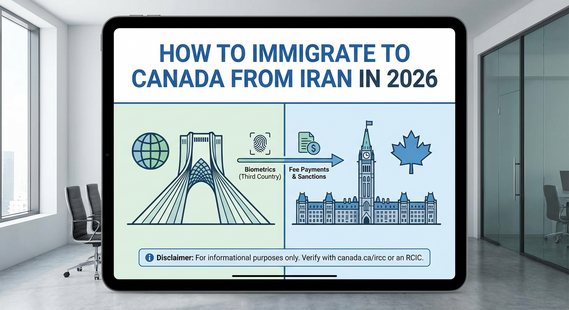
We’ve gathered the key facts and practical details Iranian nationals need when considering immigration to Canada in 2026.
No Embassy, No Consulate – What That Means for Your Application
The single most important fact for any Iranian national beginning the immigration process: Canada has had no diplomatic presence in Iran since September 7, 2012, when the Canadian government formally severed ties and closed its embassy in Tehran. The Iranian embassy in Ottawa and the Iranian consulate in Ottawa have both been closed since 2012.
Consular responsibility for Canadian matters in Iran now falls to the Embassy of Canada to Türkiye in Ankara. Switzerland acts as Iran’s protecting power in Canada. Italy acts as Canada’s protecting power in Iran.
Detail | Current Situation (2026) |
Canadian embassy in Iran | None (closed September 7, 2012) |
Consular responsibility for Iran | Embassy of Canada to Türkiye, Ankara |
Iran’s protecting power in Canada | Embassy of Switzerland, Ottawa |
Canada’s protecting power in Iran | Embassy of Italy, Tehran |
Biometrics for Iranian applicants | VAC locations in Ankara, Istanbul, Dubai, Yerevan, Tbilisi |
Official IRCC portal | canada.ca/ircc (the old cic.gc.ca domain redirects here automatically) |
ℹ CIC vs. IRCC — Terminology Note
Many older immigration guides refer to CIC (Citizenship and Immigration Canada) and the website cic.gc.ca. In 2015, the department was renamed IRCC – Immigration, Refugees and Citizenship Canada.
Today, cic.gc.ca automatically redirects to canada.ca/ircc, and all applications, including citizenship applications, are submitted through the IRCC Secure Account. References to “CIC” in older materials refer to the same department, now called IRCC.
The absence of a Canadian embassy in Iran adds time and cost to almost every step. Plan to budget for at least one trip to a neighbouring country (Turkey, UAE, Armenia, or Georgia) during your application process.
Immigration Pathways from Iran to Canada
Canada’s immigration system, managed by IRCC, offers multiple routes to permanent residence. Whether you are filing an application for permanent residence in Canada through Express Entry, a Provincial Nominee Program, or another stream, the process is conducted entirely online.
For Iranian nationals, some pathways are more accessible than others given the logistical constraints and the absence of a bilateral visa-facilitation agreement.
Pathway | Best For | Est. Timeline to PR | Iran-Specific Notes |
Express Entry – FSWP | Skilled professionals with CLB 7+ | 6–12 months after ITA | ECA required for Iranian degrees. IELTS available in Iran and Turkey |
Provincial Nominee (PNP) | Specific skills or provincial ties | 12–24 months | Fully online, no embassy visit required for main application |
Study Permit → PGWP → PR | Younger applicants, long-term path | 3–5 years total | Strong pathway post-2022. Study permit also lets you work part-time |
Work Permit → CEC | Those with Canadian job offer | 1–3 years | LMIA or LMIA-exempt stream required |
Start-Up Visa | Entrepreneurs with investor support | 12–36 months | No residency requirement while processing, popular with tech founders |
Family Sponsorship | Spouses, children, parents of PRs/citizens | 12–24 months | Sponsor must be in Canada, income thresholds apply |
Refugee Protection | Those facing persecution | Varies | Available at port of entry or inland, IRB adjudicates |
Express Entry – Federal Skilled Worker Program (FSWP)
For Iranian applicants, the critical pre-application step is an Educational Credential Assessment (ECA), WES or IQAS assess Iranian degrees against Canadian standards; allow 7–12 weeks. For language testing, IELTS General Training is available in Iran through British Council centres; CELPIP is an option for those already in Canada.
FSWP Selection Factor | Maximum Points |
Language proficiency (English or French) | 28 |
Education | 25 |
Skilled work experience | 15 |
Age | 12 |
Arranged employment in Canada | 10 |
Adaptability | 10 |
Minimum score to be eligible | 67 out of 100 |
Provincial Nominee Programs (PNP)
Each province and territory nominates immigrants whose skills and experience match local labour market needs. For Iranian nationals, British Columbia and Ontario have historically attracted the most interest.
Province | Program | Notable Streams for Iranians |
British Columbia | BC PNP | Skills Immigration – Tech Pilot, Entrepreneur Immigration |
Ontario | OINP | Human Capital Priorities, Masters Graduate, PhD Graduate |
Saskatchewan | SINP | International Skilled Worker – Occupations In-Demand |
Manitoba | MPNP | Skilled Worker Overseas; International Education Stream |
Alberta | AINP | Alberta Opportunity Stream (for those already in Alberta) |
Study Permit → Post-Graduation Work Permit → Permanent Residence
For younger applicants or those who do not yet meet Express Entry thresholds, the student pathway is structured and reliable. After completing an eligible programme at a Designated Learning Institution (DLI), graduates receive a Post-Graduation Work Permit (PGWP), which provides the Canadian work experience needed for the Canadian Experience Class (CEC) under Express Entry. As a bonus, each year of study in Canada counts as six months toward the physical presence requirement for citizenship.
Length of Study Programme | PGWP Validity |
8 months to less than 2 years | Same duration as the study programme |
2 years or longer | Up to 3 years |
Start-Up Visa
Canada’s Start-Up Visa grants permanent residence to entrepreneurs with a letter of support from a designated Canadian venture capital fund, angel investor group, or business incubator. CLB 5 language proficiency is required. The application can be processed without the applicant being in Canada, making it practical for Iranian tech founders.
Family Sponsorship
Canadian citizens and permanent residents can sponsor spouses, dependent children, and, in limited annual intakes, parents and grandparents. Sponsors must meet income thresholds and reside in Canada. Spousal processing: ~12 months, parental sponsorship is subject to annual caps.
Refugee Protection
Iranians facing persecution based on religion, political opinion, ethnicity, or gender may be eligible for refugee protection. Applications are made at a Canadian port of entry or inland IRCC office. Claims from Iranian nationals, particularly following the 2022 Mahsa Amini protests and ongoing crackdowns, continue to receive serious consideration from the Immigration and Refugee Board (IRB).
Canadian Citizenship Application: What Iranian Permanent Residents Need to Know
Once you hold Canadian permanent residence and have accumulated sufficient time in Canada, you are eligible to submit a citizenship application. For the Iranian-Canadian community, this milestone comes with a specific dual-nationality consideration that must be understood before applying.
Eligibility Requirements for Canadian Citizenship
Requirement | Adults 18–54 | Adults 55+ and Minors |
Physical presence: 1,095 days in 5 years | Required | Required |
Language proof (CLB 4 / NCLC 4) | Required | Not required |
Citizenship knowledge test | Required | 55+: required / Minors: not required |
Income tax filing (3 of 5 years) | Required if applicable | Required if applicable / Minors: not required |
Citizenship application form | CIT 0002 (adults) | CIT 0003 (minors) |
Application fee | CAD $630 | CAD $100 (minors) |
Processing time estimate (2026) | 12–18 months | 12–18 months |
The Citizenship Application Form and Submission Process
Adults use form CIT 0002, minors under 18 use CIT 0003. Both are submitted online through the IRCC secure account. After submission, IRCC runs biometrics and a background check. Applicants aged 18–54 then take the citizenship knowledge test, based on the free guide Discover Canada, before the Oath of Citizenship ceremony.
Applying for Citizenship on Behalf of a Minor
A child born in Iran with Canadian PR status can receive citizenship via CIT 0003. The applying parent must be a Canadian citizen or applying simultaneously. No knowledge test or language proof required for minors. Physical presence is calculated from the date PR was granted.
Canadian Citizenship Application Checklist
Use this checklist before submitting your citizenship application. IRCC may return incomplete applications without processing.
Document | Notes |
Completed CIT 0002 (adults) or CIT 0003 (minors) | Signed and dated, submitted through IRCC secure account |
Valid PR card or Confirmation of Permanent Residence (COPR) | Or other proof of current PR status |
All passports and travel documents – last 5 years | All pages including Iranian passport(s), supports physical presence calculation |
Physical presence calculation | Use the IRCC Physical Presence Calculator at canada.ca |
Tax filing evidence – minimum 3 years | CRA Notice of Assessment (NOA) or T1 General or online CRA confirmation |
Language proficiency evidence | IELTS / CELPIP results, Canadian degree transcripts, or employer letter |
Two citizenship photographs | 50 mm × 70 mm; plain white background; taken within 6 months |
Application fee confirmation | CAD $630 adults / CAD $100 minors, paid through IRCC secure account |
Name change documents (if applicable) | Marriage certificate, court order, or other legal document |
⚠ Canadian Citizenship Photo Requirements
Citizenship photos have stricter specifications than standard passport photos. The required size is 50 mm × 70 mm (not the common 35 mm × 45 mm passport format). The background must be plain white or off-white, and the photo must be taken within the last 6 months.
Iran-Specific Challenges: What Generic Immigration Guides Don’t Tell You
Standard immigration guides assume easy access to consular services, functioning international banking, and straightforward document authentication. For Iranian applicants, none of those assumptions hold. Here is what you need to know before starting.
Biometrics: Where to Go Without a VAC in Iran
IRCC requires biometrics (fingerprints and photo) at a Visa Application Centre, and there are no VACs in Iran. The most practical options for Iranian applicants:
- Ankara or Istanbul, Turkey – the most common choice, with multiple VAC locations and direct flights from Tehran
- Dubai, UAE – convenient for many Iranians; strong existing travel links
- Yerevan, Armenia – shorter journey for applicants in northwestern Iran
- Tbilisi, Georgia – accessible from northern Iran with direct flights
After receiving a Biometric Collection Instruction Letter from IRCC, you typically have 30 days to provide biometrics. Factor this travel into your timeline and budget early.
Paying IRCC Fees Under International Sanctions
International sanctions prevent most Iranian bank cards from processing payments to Canadian government portals. To pay IRCC fees, Iranian applicants generally need: a credit or debit card from a bank in a country where they have legal status (Turkey, UAE, Germany, etc.); or a family member already in Canada who can pay through their own IRCC account. This practical obstacle should be resolved before beginning any application.
Educational Credential Assessment for Iranian Degrees
Iranian degrees are not automatically recognised by IRCC. An ECA (WES or IQAS) is required before submitting an Express Entry profile. The key Iran-specific complication: official transcripts often must be requested through Iran’s Ministry of Science, Research and Technology, factor this into the 3–4 month total ECA timeline.
Iranian Passport Validity and Its Impact
Iranian passports are issued for 5 years – shorter than most nationalities. IRCC cannot issue a permit or document that extends beyond your passport’s expiry date. If your passport expires within two years, renew it before submitting your application. Renewing an Iranian passport from Canada requires going through the Swiss embassy in Ottawa, which acts as Iran’s protecting power. Allow extra time for this process.
IRGC Designation – Applicants with Military or Security Backgrounds
In June 2024, Canada formally listed the Islamic Revolutionary Guard Corps (IRGC) as a terrorist organisation under the Criminal Code. Senior IRGC officials and leadership figures are permanently barred from entering Canada. Any applicant who served in the IRGC or affiliated entities should seek legal advice from a licensed Canadian immigration lawyer before submitting any IRCC application. Omission of relevant history is treated as misrepresentation and can result in permanent inadmissibility.
⚠ Dual Nationality – A Critical Issue for Iranian-Canadian Citizens
Canada allows dual citizenship and does not require you to renounce another nationality. However, Iran does not formally recognise dual nationality and treats Iranian-born dual nationals as Iranian citizens only.
If you travel to Iran after obtaining Canadian citizenship, Canada cannot provide consular assistance because there is no Canadian embassy in Iran. Consider these risks carefully and seek legal advice before travelling.
Special Measures for Iranians Already in Canada (Updated March 2026)
Since the crackdown that followed the killing of Mahsa Amini in September 2022, IRCC has periodically extended special temporary measures to support Iranian nationals already in Canada. As of March 1, 2026, the current set of measures is in effect.
| ℹ Current Special Measures – Valid Until March 31, 2027 |
| Effective date: March 1, 2026 |
| Expiry date: March 31, 2027 (or earlier if revoked without prior notice) |
| Source: IRCC Revised Temporary Public Policy for Nationals of Iran, February 25, 2026 |
| Signed by: The Hon. Lena Metlege Diab, Minister of Immigration, Refugees and Citizenship |
Work Permit Extension Under Special Measures
Iranian nationals in Canada on a valid work permit may extend it under these measures without meeting the standard eligibility requirements (such as an LMIA or employer-specific arrangement). You are eligible if all of the following apply:
- You are an Iranian national with a valid Iranian passport
- You are physically in Canada with a valid work permit both when you apply and when a decision is made
- Your original work permit was issued on or before February 28, 2025
- You have not previously received a work permit extension under these special measures.
Fee Type | Amount (CAD) | Who Pays |
Work permit processing fee | $155 | All applicants |
Open work permit holder fee | $100 | Open work permit applicants only |
Biometrics fee (individual) | $85 | If biometrics required |
Biometrics fee (family) | Up to $170 | If eligible for family biometrics |
Visitors and Study Permit Holders: Standard Process Only
As of March 1, 2026, special measures apply only to work permit holders. Iranian nationals in Canada on a visitor record or study permit must use the standard IRCC process to extend their status – the special measures pathway is no longer available to them.
Why Iranian Nationals Choose Canada
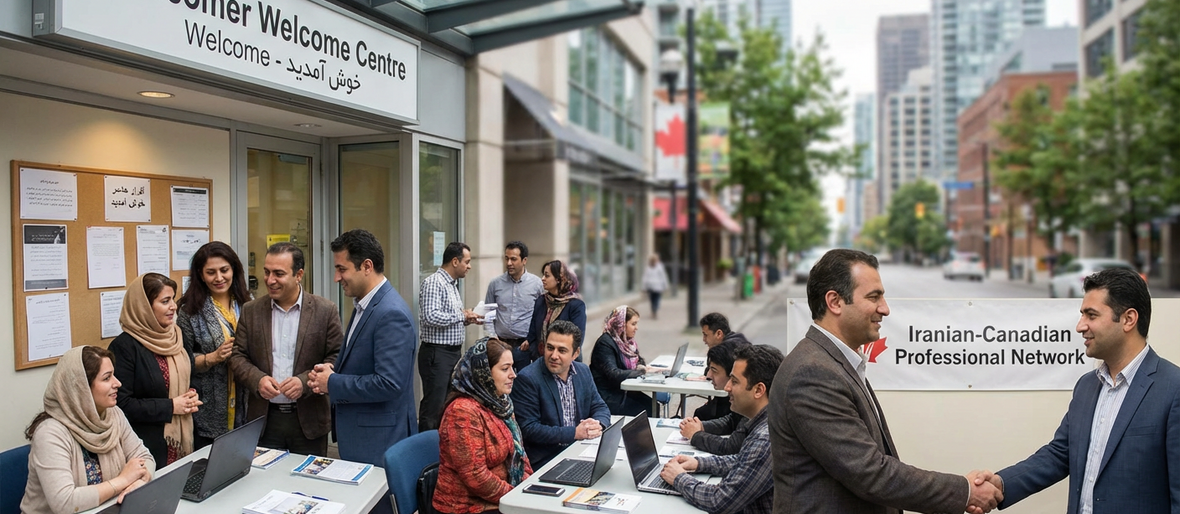
Canada’s established Iranian diaspora 280,805 strong by the 2021 census, means that in Toronto, Vancouver, and Montreal, newcomers find Persian-language services, community organisations, and professional networks from day one.
Province / Metro Area | Iranian Canadians (2021) | % of Province Pop. | Key Cities |
Ontario | 155,855 | 1.11% | Toronto, Richmond Hill, Vaughan, Markham |
British Columbia | 68,545 | 1.39% | North Vancouver, West Vancouver, Burnaby |
Quebec | 34,010 | 0.41% | Montreal |
Alberta | 15,185 | 0.36% | Calgary, Edmonton |
Other provinces | 7,210 | < 0.20% | Ottawa, Halifax, Winnipeg |
The Iranian community in Toronto, centred in Richmond Hill and North York, is the largest in Canada, with Persian-language grocery stores, media, and organisations such as the Iranian-Canadian Congress. Vancouver’s North Shore is the second major community, with strong representation in real estate, medicine, and engineering. Montreal (~34,000) and Ottawa round out the main settlement cities.
Frequently Asked Questions
Yes. All applications are submitted online through the IRCC secure account, no embassy visit required. Biometrics must be provided at a VAC in a third country. The closest options are Turkey, UAE, Armenia, and Georgia.
Yes. IRCC (Immigration, Refugees and Citizenship Canada) is the same federal department previously called CIC (Citizenship and Immigration Canada). The name changed in 2015. The old website cic.gc.ca now redirects automatically to canada.ca/ircc. All citizenship applications, permanent residence applications, and other IRCC processes go through the same department under its current name.
Iranian bank cards are blocked by sanctions. Use a card from a bank in Turkey, UAE, or Germany or ask a family member in Canada to pay through their IRCC account. Resolve this before starting, as fees must be paid to submit.
Canada permits dual citizenship and does not require renouncing any other nationality. However, Iran does not recognise dual nationality. If you travel to Iran on your Iranian passport after becoming a Canadian citizen, Canada has no embassy in Iran and no consular access to assist you if you face legal problems there. This does not prevent you from obtaining Canadian citizenship, but travel to Iran afterward carries real and documented risks. Seek legal advice specific to your situation before deciding.
Based on IRCC’s published estimates as of early 2026, standard adult citizenship applications are taking approximately 12 to 18 months from submission to ceremony. Processing times are updated monthly at canada.ca/ircc under “Check processing times.”
Yes, if your child is a Canadian permanent resident. Use form CIT 0003. The applying parent or guardian must be a Canadian citizen or be applying simultaneously. Minors do not need to take the knowledge test or demonstrate language skills. The physical presence requirement applies, calculated from when the child received PR status.
Citizenship photos must be 50 mm × 70 mm (not standard passport size), plain white background, taken within 6 months. Confirm with the photographer – wrong specs are a common delay reason.
You may be eligible if: you are an Iranian national in Canada with a valid work permit; your original work permit was issued on or before February 28, 2025; and you have not previously received an extension under the special measures. The deadline to apply is March 31, 2027. Visitor record and study permit holders must use the standard extension process instead.
Standard compulsory military service does not automatically make a person inadmissible. However, membership in or affiliation with the IRGC, designated a terrorist organisation by Canada in June 2024, is grounds for inadmissibility, particularly for senior officers and leadership. If you have any background involving the IRGC or affiliated organisations, consult a licensed Canadian immigration lawyer before submitting any application. Non-disclosure of relevant history constitutes misrepresentation and leads to permanent inadmissibility.
Official resources:
- All IRCC applications and processing times: https://www.canada.ca/en/immigration-refugees-citizenship.html
- Form CIT 0002 – Application for Canadian Citizenship (Adults): https://www.canada.ca/en/immigration-refugees-citizenship/services/application/application-forms-guides/cit0002.html
- Form CIT 0003 – Application for Canadian Citizenship (Minors): https://www.canada.ca/en/immigration-refugees-citizenship/services/application/application-forms-guides/cit0003.html
- IRCC Physical Presence Calculator: https://www.canada.ca/en/immigration-refugees-citizenship/services/application/application-forms-guides/cit0555.html
- IRCC Special Measures for Iranians in Canada: https://www.canada.ca/en/immigration-refugees-citizenship/services/iran.html
This article does not represent Immigration, Refugees and Citizenship Canada or any government body. For personalised advice, consult a Regulated Canadian Immigration Consultant (RCIC) or a licensed immigration lawyer.